
Six College Athletic Directors Take on the Future of Sports — and Why It Matters for Every High School Athlete in Texas
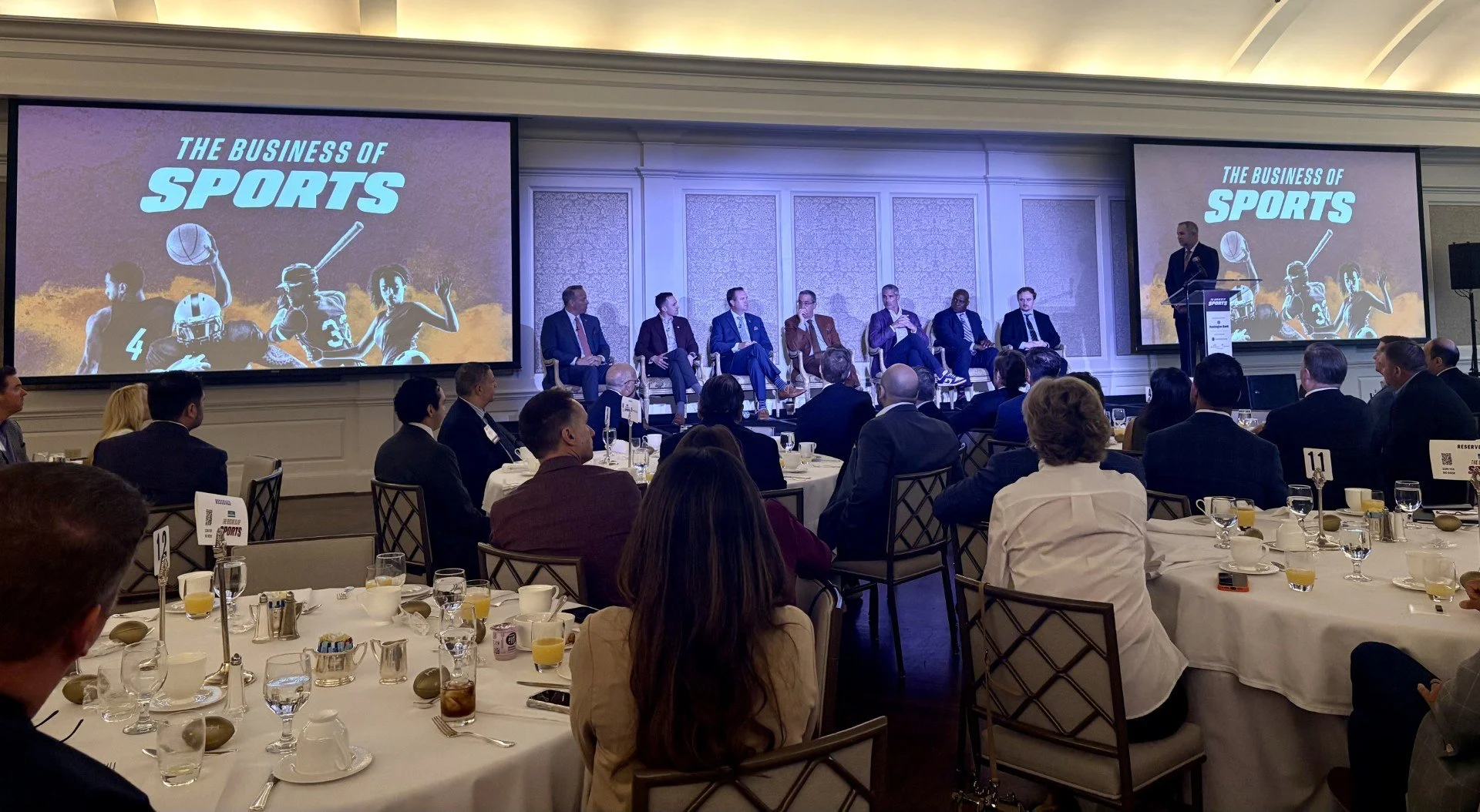
Houston Business Journal brings together some of the most influential Texas athletic directors to discuss how college programs shape local economies and the overall business of sports.
Takeaways from the Houston Business Journal’s Business of Sports 2026 panel, recently held at River Oaks Country Club.
We recently attended the Houston Business Journal’s Business of Sports 2026 panel at River Oaks Country Club — a conversation with six of the most influential athletic directors in college sports. Across the stage we hear from: Verge Ausberry from LSU, Mike Buddie from TCU, Chris Del Conte from UT, Tommy McClelland from Rice, Taylor McGillis from Texas A&M, and Eddie Nuñez from the University of Houston.
The discussion covered a lot of ground — revenue sharing, the transfer portal, women’s sports investment, fan experience and the mental health pressures on student athletes. They covered a lot of ground and it was apparent that the college sports landscape is changing faster than most high school athletes and their families realize. And the ones who understand that — early — will have a meaningful advantage.
Here are the themes that resonated most, and why they matter well beyond the college level.
The Business of College Athletics Has Outgrown the Old Model
Chris Del Conte from UT put it plainly: the Longhorns operate with a $407 million athletic budget, entirely self-sufficient, with football and men’s basketball generating the revenue that funds everything else. Not a dime from the university. And even with that budget, he acknowledged the financial pressure is real — “whether you think you’ve got enough,” he said, “the $50 million to make ends meet or $400 million, you don’t.”
The broader point is this: college athletics is now unambiguously a business, and the athletic directors on that stage are running it like one. Revenue generation, brand alignment, roster management as a P&L exercise — these are the conversations happening in athletic departments today. The model has shifted permanently.
For student athletes, that shift has a direct implication: the institutions recruiting them are making decisions based on brand value, not just athletic performance. A recruit who arrives with a clear personal brand and an understanding of NIL are a must.
We spoke directly with Nuñez from University of Houston and asked what high school athletes should be thinking about when it comes to NIL. When we asked, “What do they need to know now?” he confirmed what we’re already focused on in our NIL trainings with high school athletes: communication skills. Nuñez says high school athletes need to practice at the podium, watch news clips (not just highlight reels and film) and keep up with current events to better understand what it takes to clearly communicate and perform well under pressure beyond the playing field. The Dala team is already doubling down on communication. This skillset is one all high school athletes need to represent a program well and is genuinely more valuable when navigating this new landscape.
High School Recruiting Still Matters — but the Window Is Narrowing
The transfer portal dominated a significant portion of the conversation. Del Conte noted that UT has always been and will remain a high school recruiting program — they’re committed to recruiting based on potential, not just production. But he was candid that the portal has changed the calculus for nearly every other program, with some rosters drawing 65% or more of players from transfers rather than prep athletes.
What that means for high school athletes is nuanced. At elite programs, the pipeline from high school still matters deeply. But the competition for those spots is now measured not just against other high school prospects — it’s measured against proven college athletes available through the portal. High school recruits need to bring something those transfers can’t: upside, fit, and a story a program can build around.
That’s a brand conversation as much as it’s an athletic one.
Women’s Sports Are Growing Fast — and the Investment Is Following
Rice was the only Division I school in Texas without women’s golf remarked McClelland. He described how a major philanthropic gift from a former student athlete changed that when a female alum said, “I want women’s golf, and I’m going to fund the entire program.” It became the largest female philanthropy gift in Rice Athletics history, launching a program that already has one of the top recruiting classes in the country for its inaugural year.
The broader message from the panel was consistent: women’s sports are not a future investment, they’re a current one. Volleyball, basketball, softball, gymnastics, flag football — the audiences are growing, the television exposure is expanding, and the donor interest is real.
For female student athletes, this is a significant moment. The NIL landscape for women’s sports is still developing, but the brand-building opportunity is arguably greater right now than it will be once the market matures. Athletes who establish their personal brand early — before the recruiting calls, before the NIL deals — are positioned to take advantage of a wave that’s still building.
The Mental Health Conversation Is No Longer Optional
Mental health among young athletes was another topic of discussion. Ausberry, LSU’s AD, raised genuine concern about what happens to young athletes who suddenly have NIL income, public profiles, and the pressure of families and agents around them, without the preparation to navigate any of it. Another panelist raised the pro sports parallel of athletes who struggle when their playing career ends, regardless of what’s in their bank account.
The panel provided a clear-eyed acknowledgment that the industry has moved fast and the support structures for young athletes haven’t fully caught up. Preparation matters. Media training, financial literacy, understanding your own brand and story before someone else defines it for you — these aren’t extras. They’re the foundation.
When Dala spoke directly with Ausberry after the event, we took the opportunity to ask him: “Beyond mental health, what else should high school athletes do to prepare for the NIL landscape?” He emphasized the importance of an education because not everyone will achieve seven- and eight-figure deals. He wasn’t discouraging athletes but instead was underscoring the reality for many young athletes who either don’t get the big brand deals or even for those athletes who do, because eventually a sports career ends.
This is a good lesson for any high school student athlete: your sport will not always be the thing that defines you. The young athletes who build something beyond the sport — a brand, a story, a set of communication skills — are the ones who navigate that transition well.
What This Means for High School Student Athletes Right Now
A student athlete who understands their own value — who can speak to it, represent it, and grow it — is a different kind of prospect than one who simply shows up with a highlight reel.
NIL rights for high school athletes in Texas are still evolving, but the preparation window is now. Texas took a meaningful step in 2025, and the landscape will continue to shift but those athletes who arrive at that moment, already knowing how to tell their story and manage their public presence, will have a real advantage to be a part of a college’s brand story over those starting from scratch.
At Dala, that’s exactly what we’re working on with our NIL personal branding and media training program for student athletes — bringing the same strategic communications approach we’ve used with Fortune 500 clients and professional sports organizations to the next generation of athletes who deserve the same tools. If the sports panel reinforced anything, it’s that the time to build that foundation is well before the recruiting calls start and communication is at the heart of each athlete’s sports playbook.
To learn more about Dala’s NIL programming for student athletes, check out our FAQ or reach out to our NIL consultant Lesley Berry, who brings more than two decades of professional sports marketing experience — including 10+ years with the Dallas Mavericks — to this work.